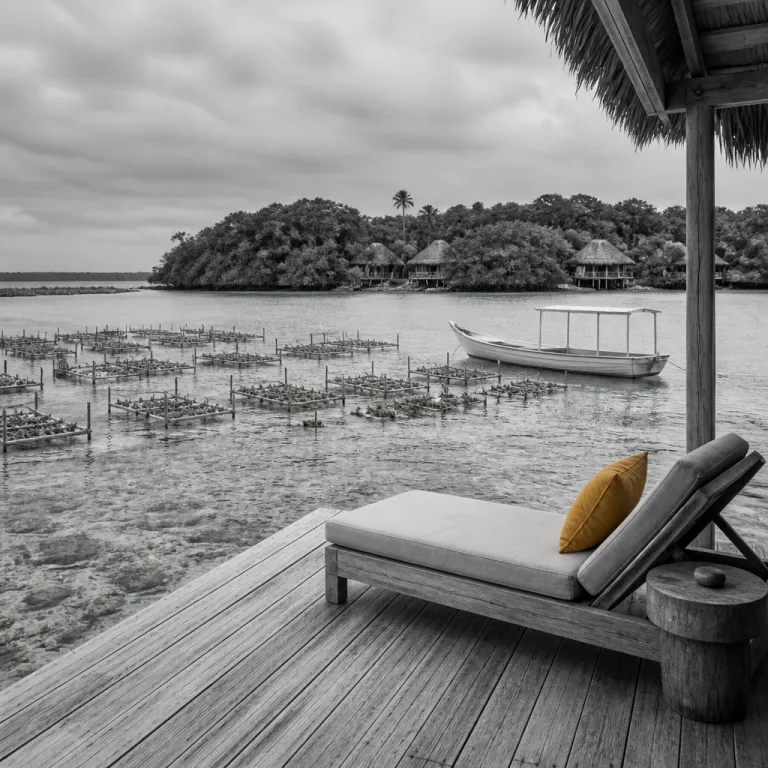
The conservation premium: why these islands now cost more
In Indonesia, the phrase conservation luxury resort Indonesia now signals a very specific kind of stay. It means a remote island retreat where your nightly rate funds marine conservation, community projects, and the infrastructure required to live lightly on fragile reefs. These properties sit far beyond the usual Bali circuit, yet they are reshaping what people consider great value at the top end.
Misool Eco Resort in Raja Ampat, Bawah Reserve in the Anambas Archipelago, and Nihi Sumba on Sumba Island all charge rates that exceed many standard five-star hotels. Misool’s seven-night packages start around $4,175 (based on recent published packages), Bawah Reserve’s nightly rate is typically around $1,980 (according to direct booking data), and Nihi Sumba’s villas often begin near $1,495 per night (as listed in current rate sheets). Those numbers look steep until you unpack how each resort allocates revenue between operations, conservation, and local partnerships.
Think of the conservation premium as a bundled fee for both a room and a functioning conservation area. At Misool, a significant share of what guests have booked supports a 300-square-kilometer marine reserve where fishing is banned and reef monitoring is constant; independent surveys commissioned by the Misool Foundation have recorded reef fish biomass increases of more than 250% in some zones over a decade. At Bawah Reserve, the cost of running a largely solar-based power system across six islands, plus water desalination and waste management, is built into the inclusive resort model and detailed in the property’s sustainability reports. On Sumba, Nihi’s pricing quietly underwrites the Sumba Foundation’s work in health, education, and clean water for nearby villages, which now reaches tens of thousands of local residents each year according to the foundation’s impact updates.
For a solo explorer comparing hotels, the question is not only whether a resort has a beautiful beach or a large pool. The sharper question is whether the higher rates at a conservation-led island retreat actually translate into measurable gains for marine life and local people. When you read reviews, look for specific references to marine conservation programs, village partnerships, and transparent reporting, rather than vague mentions of being eco-friendly or green.
There is also a more nuanced side to the conservation premium. Even at the most committed Indonesian conservation retreats, only a portion of each dollar can flow directly into reef patrols or community projects once salaries, maintenance, and transport are covered. Impact reports from operators such as Misool and the Sumba Foundation outline how funds are split between operations and conservation, but the ratios vary by property and season. Understanding that breakdown, and asking how much of your spend supports long-term protection versus guest-facing luxury, is essential for avoiding greenwashing and deciding whether the higher price aligns with your own priorities.
Misool Eco Resort: reef protection with real local stakes
Misool Eco Resort sits on a private island in southern Raja Ampat, surrounded by some of the richest marine life on the planet. The resort’s founders helped establish a no-take conservation area around the island resort, turning former shark-finning grounds into a sanctuary where fish biomass has rebounded dramatically; long-term monitoring by independent scientists, summarized in Misool Foundation impact reports, has documented shark numbers increasing by more than 25 times in certain sites. This is conservation luxury resort Indonesia at its most uncompromising, and the pricing reflects that ambition.
The Misool team runs reef patrols, funds ranger stations, and employs villagers from nearby islands in roles that go far beyond housekeeping. Their village partnership model channels money from each booked stay into education, alternative livelihoods, and long-term marine conservation, so the community has a direct stake in keeping the conservation area intact. According to recent impact reports, hundreds of local people now benefit from scholarships, healthcare support, and conservation-linked jobs. Guests do not just hear about these initiatives in brochures; they see patrol boats leaving the small harbor, meet rangers at the conservation center, and can join briefings on how the reserve is managed.
On the water, the difference is visible from the first snorkel off the white-sand beaches. Reef sharks cruise in the shallows, schools of fusiliers cloud the drop-offs, and coral gardens begin almost at the sand line, a contrast to more heavily trafficked islands near Bali where marine life has thinned. When you compare rates with a standard resort that offers a pretty pool and generic spa treatments, Misool’s pricing starts to look less like a markup and more like a conservation levy that keeps the ecosystem functioning.
For travelers tracking sustainability credentials, Indonesia’s Green Parekraf certification has become a useful filter for separating marketing from measurable practice. Properties that align with this framework often see booking velocity gains because guests can verify that their money supports real conservation, not just recycled towels. If you want to go deeper into how this certification now shapes luxury bookings, read our guide to the Green Parekraf sustainability stamp for Indonesian luxury hotels.
Bawah Reserve: solar powered seclusion in the Anambas
Bawah Reserve is the clearest example of conservation luxury resort Indonesia where infrastructure itself is an environmental project. Set across six small islands in the Anambas Archipelago, this private island resort operates almost entirely on solar energy, with water desalination and careful waste systems built into the design from day one. The result is a self-contained conservation area where the resort bawah model treats energy, water, and waste as core guest-facing features, not back-of-house details.
Rates at Bawah Reserve are high because the property functions as both an inclusive resort and a remote engineering project. Your stay covers seaplane transfers, overwater bungalows or beach suites, spa treatments, non-motorized water sports, and all meals in a collection of restaurants and bars that are surprisingly refined for such an isolated island. Behind the scenes, the team maintains solar arrays that supply the vast majority of the resort’s power, manages a marine conservation program, and funds coral restoration around the private islands, all of which require specialist staff and constant monitoring documented in Bawah’s sustainability statements.
Walking along the white-sand beaches at Bawah, you notice how little hard infrastructure touches the shoreline. Villas sit back from the sand, boardwalks float above seagrass beds, and the main pool is tucked into the natural contours of the island rather than carved out of the reef flat. Snorkeling from the beach reveals healthy coral bommies and juvenile fish using the shallows as a nursery, a direct payoff from years of careful marine life management and strict limits on boat traffic.
For many guests, the conservation story becomes real in small, daily rituals. A guide might explain how the resort’s water comes from a central treatment plant rather than plastic bottles, or how the inclusive resort pricing allows Bawah Reserve to fund marine patrols without chasing volume-based occupancy. When you read courtesy Bawah photo captions or guest reviews that mention the quiet hum of solar-powered systems instead of diesel generators, you are seeing how sustainable luxury can feel both technically advanced and deeply restful.
Sumba’s Nihi: community first on a wild surf coast
On Sumba, Nihi has become shorthand for a different flavor of conservation luxury resort Indonesia, one that leans into culture and community as much as coral. The resort stretches along a remote beach of pale sand and powerful surf, far from the polished coasts of southern Bali. Here, the conservation area is less about a reef and more about a social landscape of villages, rituals, and ancestral land rights.
Nihi’s partnership with the Sumba Foundation channels a portion of each booked stay into clinics, schools, and clean water projects in nearby communities. Guests can visit these initiatives with guides who explain how the foundation’s work reduces childhood illness, supports education, and creates alternatives to slash-and-burn agriculture that can damage watersheds. Recent foundation updates highlight thousands of patients treated annually and dozens of schools supported, illustrating how guest spending translates into tangible outcomes. This is where the conservation narrative shifts from marine life to human resilience, yet it remains central to why rates sit above many conventional island resort options.
On property, the luxury is understated but precise. Villas open onto private pools and wide decks facing the beach, while restaurants and bars serve food that draws on local produce without turning every plate into a lecture on sustainability. Spa treatments take place in hilltop pavilions where the soundscape is more likely to be distant waves and village drums than background music, reminding you that this private island style seclusion exists within a living cultural matrix.
For solo travelers, the appeal lies in how Nihi balances privacy with genuine contact. You can spend a morning riding along sand beaches, an afternoon surfing an empty break, and an evening listening to staff talk about how Sumba’s megalithic tombs and pasola rituals shape land use. Compared with a standard resort where conservation is a line on the website, this level of integration between rates, community projects, and guest experience explains why Nihi commands a premium.
How to read the price tag: value, verification, and booking strategy
When you compare a conservation luxury resort Indonesia with a conventional five-star hotel, start by breaking down what the rate actually includes. At places like Bawah Reserve and Misool, the nightly price often covers transfers, full-board dining, guided activities, and access to a protected conservation area that would cost extra elsewhere. A city hotel with a rooftop pool and a good beach club partnership may look cheaper on paper, but once you add meals, excursions, and transport, the gap narrows.
The more important question is how much of your spend reaches conservation and community programs. Serious operators publish impact reports, list marine conservation partners, and explain how many local people they employ in skilled roles, not just entry-level jobs. When you read reviews, look for guests mentioning ranger briefings, village visits that feel respectful rather than staged, and on-site evidence of solar arrays, water treatment plants, or reef restoration projects.
Healthy skepticism is useful, because conservation has become a fashionable marketing term in luxury travel. Some resorts talk about sustainable luxury while still running diesel generators all night, importing most food by air, and offering little transparency on waste or water use. Before you visit, ask for documentation on certifications, audits, or partnerships, and pay attention to whether the answers are specific or vague.
For solo explorers planning a route through Bali and the outer islands, it can help to mix one high-impact conservation stay with more modest hotels you love for their character and location. Our guide to elegant Bali beachfront escapes outlines properties where you can enjoy a great beach and refined service without the full conservation premium. Then, when you finally step onto a private island in Raja Ampat or the Anambas, you know that the higher rate is not just buying white sand and overwater bungalows, but a functioning conservation system that will still be there when you return.
Booking tips for Indonesia’s conservation led resorts
Planning a stay at a conservation luxury resort Indonesia requires more lead time and more research than a standard city break. These properties are small by design, often with fewer than 40 keys, and peak season dates can be booked a year in advance. If your travel window is fixed, secure the resort first, then build the rest of your itinerary around it.
Start by clarifying what kind of conservation focus matters most to you. If marine life is your priority, a place like Misool or Bawah Reserve, with clear marine conservation programs and protected sand beaches, will feel more aligned than a mainland resort with a nice pool but little environmental impact. If you are more interested in cultural immersion, Nihi’s village-based projects on Sumba may offer a better fit, even if the beach is wilder and the logistics more complex.
When comparing rates, ask each resort for a breakdown of what is included and what is extra. Inclusive resort models can look expensive until you factor in transfers, equipment, and guided activities that would otherwise add up quickly, especially in remote islands where local options are limited. Pay attention to whether spa treatments, non-motorized water sports, and conservation center visits are part of the package, or priced à la carte.
Finally, keep an eye on how each property communicates its impact over time. Resorts that treat conservation as core to their identity will share updates on reef health, community projects, and new initiatives, often with the phrase “All rights reserved” tucked into detailed reports rather than glossy marketing alone. As one operator explains in their own words, “Why are these resorts more expensive? They offer exclusive experiences and fund conservation efforts.” and “What activities are available? Diving, snorkeling, cultural tours, and wellness programs.” and “How do these resorts support conservation? Through marine protected areas and community initiatives.”
FAQ: conservation led luxury resorts in Indonesia
Why do conservation focused resorts in Indonesia charge higher rates ?
Resorts such as Misool Eco Resort, Bawah Reserve, and Nihi Sumba build the cost of conservation directly into their pricing. Your rate helps fund marine protected areas, solar and water infrastructure, and community programs that would not exist without guest spending. This means you are paying for both a luxury stay and the long-term protection of the surrounding environment and communities.
How can I verify that a resort’s conservation claims are genuine ?
Look for clear evidence such as published impact reports, named conservation partners, and third-party certifications like Indonesia’s Green Parekraf program. On site, you should be able to see infrastructure such as solar panels, water treatment systems, and active conservation centers, not just signage. Guest reviews that mention ranger patrols, reef monitoring, or village projects are another useful indicator.
What types of activities can I expect at these conservation resorts ?
Most conservation led properties offer snorkeling, diving, and guided nature walks that highlight local marine life and ecosystems. Many also include cultural visits to nearby villages, wellness programs, and spa treatments that draw on local traditions. Because these are remote islands, non-motorized water sports and low-impact excursions tend to be prioritized over high-speed activities.
Is a conservation luxury resort suitable for solo travelers ?
Yes, these resorts can be excellent for solo explorers who value depth over nightlife. Small guest numbers and shared conservation activities make it easy to meet like-minded people while still enjoying privacy in your villa or overwater bungalow. The main consideration is budget, as single occupancy in high-end rooms can be costly, so plan your stay as the centerpiece of a longer Indonesian journey.
How far in advance should I book Misool, Bawah, or Nihi ?
Because these resorts have limited rooms and strong repeat business, peak periods often fill many months ahead. If you are targeting specific dates or room categories, aim to book at least nine to twelve months in advance. Shoulder seasons can offer more flexibility, but flights to remote islands still require careful coordination.